Every unlabelled cable is a future outage with a longer repair time. We trace, identify, and label every cable in your comms room, then hand over documentation that turns "which one is it?" into a five-second lookup — for your team, your MSP, and whoever comes after them.
Prefer to talk? Call Chris — 0412 853 618
One mystery cabinet or a whole building — send a photo of the comms room and Chris will come back with straight advice and a fixed price. Prefer to talk? Call 0412 853 618. No pushy sales, just solid work.
When a port dies at 9am on invoice day, the difference between a five-minute fix and a two-hour fault hunt is whether anyone knows which cable feeds it. Cable labelling is unglamorous, inexpensive, and pays for itself the first time anything goes wrong — which is exactly why it's the most commonly skipped step in cabling installed on the cheap.
Unified Network Solutions traces, identifies, labels, and documents network cabling across Brisbane and South East Queensland — from single mystery cabinets through to multi-floor buildings where a decade of ad-hoc changes has erased any record of what goes where. As ACMA Open Cablers (#42489) we label to AS/CA S009, and every job hands over a cable register and port map your IT team can actually maintain. Cable tracing is the rescue half of this trade: cable tracing finds what the labels should have said, and proper cable tracing ends with the labels finally saying it.
Everything between "no idea what this cable is" and "fully documented network."
Machine-printed, durable labels at both ends of every run — patch panels, switch ports, wall outlets, and the cables between them — following one consistent convention across the site.
Tone-and-probe tracing of unknown runs, live or dead — through ceilings, walls, and risers — until every cable in the cabinet has a confirmed far end and a name.
Every patch panel port mapped to its outlet, every switch port mapped to its panel — recorded in a register that makes moves, adds, and changes a desk job instead of a ceiling job.
Cable registers, port maps, floor-plan outlet marking, and cabinet photos — delivered digitally as PDF plus an editable spreadsheet your team keeps current.
A full stocktake of what's actually installed: cable counts, categories, conditions, abandoned runs, and compliance issues — the factual starting point for any upgrade decision.
Finding where cabling physically runs through a building — essential before renovations and fitouts so the demolition crew doesn't take your network out with the partition walls.
Tracing is the detective work that makes cable labelling possible — you can't label what you can't identify, and on most rescue jobs the identifying is nine-tenths of the effort. For cables carrying traffic, we identify runs with non-disruptive methods — nothing gets unplugged during business hours to find out where it goes. For dead, dark, or abandoned cables, tone-and-probe equipment induces a signal at one end and follows it through walls, ceiling spaces, and risers to wherever the other end turns out to be.
The result of a cable tracing pass is certainty: every run in the cabinet has a confirmed origin, destination, and purpose — including the ones that turn out to go nowhere. On older Brisbane sites it's common for a quarter of the cables in a cabinet to be abandoned legacy runs from tenants two leases ago. Abandoned runs get flagged for removal rather than left to confuse the next technician, and mystery cables stop being mysteries.
Tracing pairs naturally with cable certification: once we know what every run is, testing tells you how well each one performs — the complete picture of your cabling in one visit.
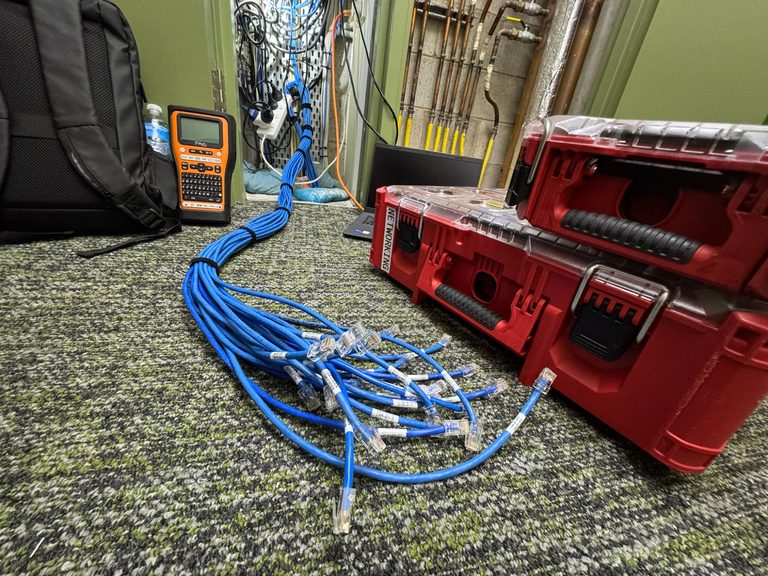
A label is only useful if the next person can decode it. Convention matters more than the label gun.
Cabinet / panel / port identifiers (e.g. A1-P07) agreed with your IT team before the first label prints — and if you already run a convention at other sites, we adopt yours rather than invent a competing one.
Every cable labelled at the patch panel end and the outlet end, so identification never depends on tracing the run again. The label at one end tells you exactly where the other is.
Machine-printed labels that survive heat, handling, and a decade in a ceiling space — meeting AS/CA S009 requirements, not handwriting on insulation tape that's gone by Christmas.
Our favourite before-and-after work: the cabinet nobody wants to open. A decade of contractors, no two using the same system, nothing written down, and the one person who knew it all left years ago. We see this cabinet every week somewhere in Brisbane, and the fix is methodical rather than magic.
Day one: trace everything. Every cable identified live or by tone — origin, destination, purpose — including the abandoned runs that get flagged for removal. No assumptions; every run confirmed.
Then: label and re-dress. Both ends labelled to the agreed convention, patch leads replaced at correct lengths where needed, and the cabinet re-dressed into proper cable management so it stays readable.
Handover: the missing documentation. Cable register, port map, and photos — the paperwork the room should have had all along, in a format your IT team or MSP can keep current. From archaeology to administration in a couple of days.
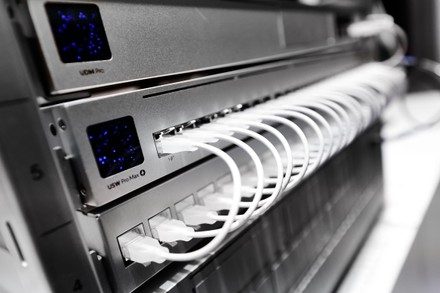
Labels answer "which cable is this?" — documentation answers everything else. Good cable labelling without the register is only half the job. Every labelling job hands over a digital pack: a cable register listing each run with its label, endpoints, and cable type; a port map of every panel and switch; outlet locations marked on floor plans where applicable; and photos of the finished cabinets.
It's delivered as PDF for the record and an editable spreadsheet for daily use, so the documentation survives staff turnover, MSP changes, and office moves. When the network changes, your team updates a row — and the room stays as readable as the day we left it.
For sites that already have partial records, we reconcile what exists against what's actually installed rather than starting from zero — keeping whatever convention and history is worth keeping.
Nobody books cable labelling for fun. These are the moments Brisbane businesses actually call us — and in every one, doing it then is far cheaper than doing it during the emergency that follows.
The new provider inherits a network with no map. Cable labelling and a documentation pack turns their onboarding from weeks of discovery into days — and stops you paying their hourly rate to re-learn what the old provider knew.
Before a fitout or relocation, cable labelling plus an audit establishes exactly what exists and what's reusable. After one, it makes sure the new install doesn't start its life as the next mystery cabinet.
The classic trigger: a fault took hours instead of minutes because nobody could identify the cable. Labelling the room afterwards is the cheap way to make sure that bill never repeats.
There's also the quiet trigger: insurance, audits, and compliance. Cable labelling to AS/CA S009 with proper records is part of demonstrating your infrastructure is professionally maintained — paperwork that matters more every year in regulated industries and managed buildings.
A site visit or cabinet photos tell us the cable count and how much tracing is needed. Fixed price — no hourly surprises on jobs where the unknowns are the point.
Every run confirmed — live identification for active cables, tone-and-probe for dead ones — without disrupting your working network.
Machine-printed labels at both ends to the agreed convention, cabinets re-dressed where needed so the result stays readable.
Cable register, port map, photos — PDF plus editable spreadsheet, so the documentation keeps working after we leave.
Labelling is detail work — it suits people who genuinely care that the cabinet is right.
ACMA Open Cabler registered (#42489) with comprehensive insurance — labelling and any remediation done to AS/CA S009 by people qualified to touch the cabling, not just read it.
We document networks the way IT teams actually use them — port maps and registers that match how faults get diagnosed, not just where cables physically sit.
White-label documentation work for IT companies and MSPs taking over messy client sites — we make the comms room make sense, you keep the relationship.
It depends on the number of cables and how much tracing is needed — labelling a documented room is quick, while identifying a fully unknown cabinet takes real time per run. As a guide, small comms rooms are usually a few hundred dollars to fully trace, label, and document, with per-cable rates dropping on larger jobs. Fixed-price quote after a site visit or photos — call Chris on 0412 853 618.
A typical single-cabinet comms room — 24 to 48 ports plus switching — is usually traced, labelled, and documented in a day. Larger rooms, multiple cabinets, or sites where most cabling is unidentified take longer because every unknown run has to be traced before it can be labelled. We scope it during a quick site visit or from photos and quote a fixed price.
Machine-printed, durable labels at both ends of every cable, following a consistent convention agreed with your IT team before we start — typically cabinet/panel/port based (e.g. A1-P07) so any technician can locate both ends of any run instantly. We follow AS/CA S009 labelling requirements, and where you already have a convention across other sites we adopt it rather than inventing a new one.
Yes. Dead, dark, or disconnected cables are traced with tone-and-probe equipment that doesn't need an active link — we induce a tone at one end and locate it at the other, even through walls and ceiling spaces. Live cables are identified with non-disruptive methods so we never have to unplug anything to figure out where it goes.
Yes — most of our labelling and tracing work happens in operating businesses. Identification methods are chosen so nothing needs to be disconnected during business hours, and on the rare occasion a port has to be briefly interrupted to confirm identity, we schedule it after hours or in an agreed window.
A digital documentation pack: a cable register listing every run with its label, endpoints, and cable type; a port map of every patch panel and switch; floor plans marking outlet locations where applicable; and photos of the finished cabinets. Delivered as PDF plus an editable spreadsheet so your IT team or MSP can keep it current as the network changes.
We flag them in the documentation with photos and a plain-English note on what's wrong — damage, non-compliant separation from power, abandoned runs, or cabling that fails its claimed category. You get an honest picture and a separate quote for remediation; nothing is fixed without your say-so, and nothing found is buried. Where performance is in question, certification testing settles it with numbers.
We service Brisbane CBD, North Brisbane, South Brisbane, Gold Coast, Sunshine Coast, Ipswich, Logan, Moreton Bay, Redlands, and the wider South East Queensland region. For larger projects, we can service regional Queensland by arrangement.
We provide cable labelling, tracing, and network documentation across Brisbane CBD and metro, Logan, Ipswich, Redlands, Moreton Bay, the Gold Coast, and the Sunshine Coast. Single cabinets, multi-floor buildings, and multi-site MSP cable labelling engagements — quoted fixed-price, done in live environments without drama, and handed over with documentation that outlasts the people who ordered it. Cable tracing for the cabinets nobody documented — cable tracing with instruments, then labels so the cable tracing never needs repeating.
Send a photo of the cabinet that haunts you and we'll quote a fixed price to trace it, label it, and document it properly — once, permanently. Cable tracing first, labels second, mystery never again.
Call 0412 853 618 Get a Quote Online Unified Network Solutions