You know the cabinet. The one nobody opens in front of clients, where every fault hunt starts with twenty minutes of archaeology. We turn it into the other kind — traced, dressed, labelled, documented — and it stays that way, because we fix the system, not just the look.
Prefer to talk? Call Chris — 0412 853 618
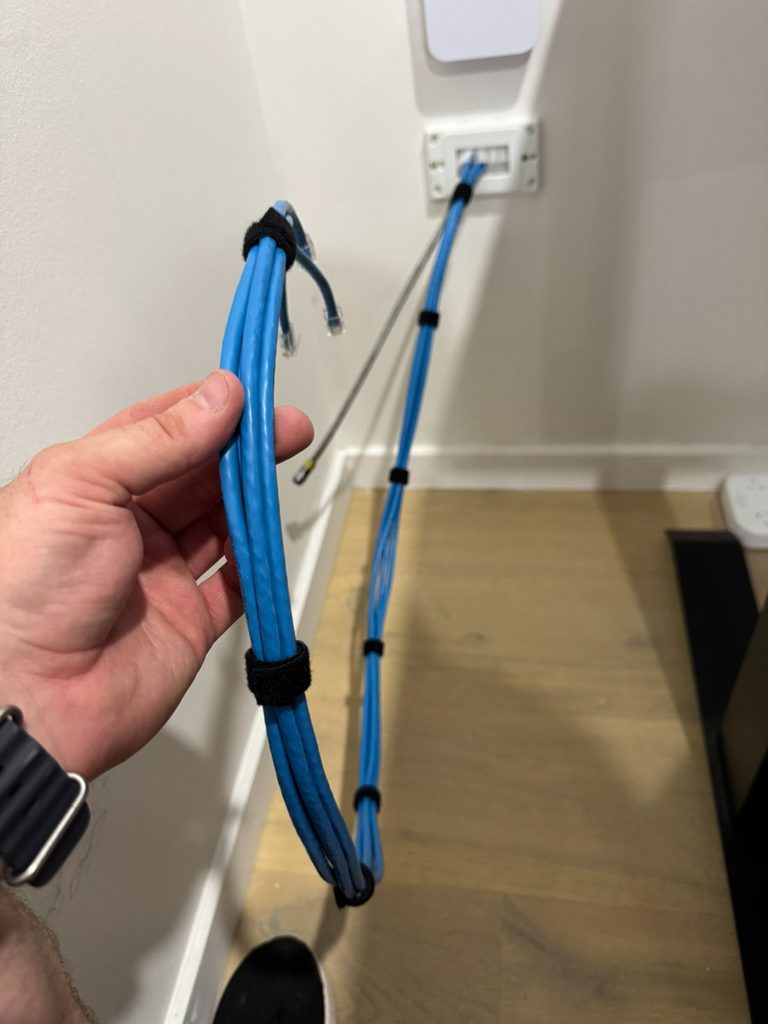
Send a photo of the cabinet — honestly, that's all we need for a remarkably accurate fixed price. Prefer to talk? Call 0412 853 618. No judgement on the spaghetti; we've seen far worse.
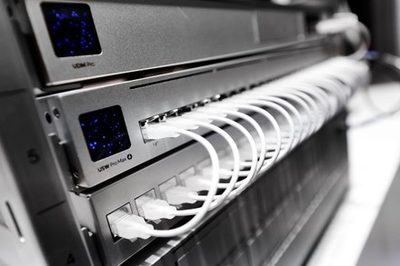
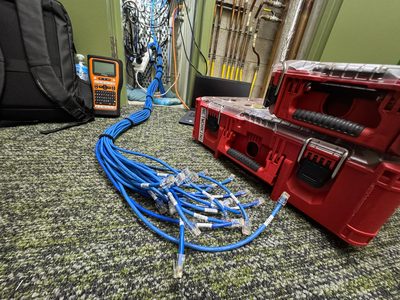

Every comms cabinet drifts toward chaos — one urgent patch at a time, one contractor in a hurry at a time, until the rack is a solid mass of looped leads nobody dares touch and the switch lives behind a curtain of blue. Server room cable management reverses the drift: every cable traced and labelled, leads replaced at correct lengths, dressing that restores airflow and access, and the documentation that stops the rot returning.
Unified Network Solutions delivers server rack cable management and comms room remediation across Brisbane and South East Queensland — single cabinets through to building MDF rooms carrying a decade of tenant history. As ACMA Open Cablers (#42489) we do it in live environments with minimal-to-zero downtime, and as IT people we document it the way the next technician actually needs. The before-and-after photos are the fun part; the port map is the value.
The word "tidy-up" undersells what actually happens. A proper rack remediation runs in a strict order, because in a live cabinet, sequence is safety — the difference between a renovation and an outage is which cable moved first. First, everything gets traced and identified — every patch lead, every run, every mystery cable from the 2017 fitout — so nothing is ever unplugged on a hunch. The tracing and labelling pass is the foundation the rest stands on.
Then the rebuild: switches and panels repositioned where layout fights serviceability, new patch leads at measured lengths replacing the loops, cables dressed into vertical and horizontal management with velcro, and both ends of everything labelled to one convention. Abandoned cables come out entirely — a third of the volume in a bad cabinet is often dead weight.
Last, the proof: photos, a port map, and a cable register. A typical single-rack remediation is a one-day job; the worst multi-rack archaeology runs two to three. Either way the cabinet leaves the project serviceable by any technician who can read.
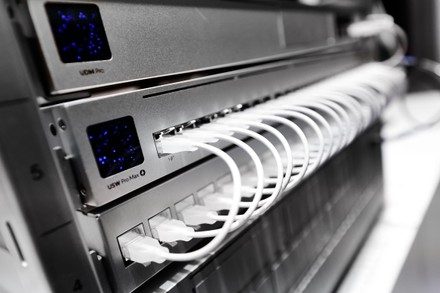
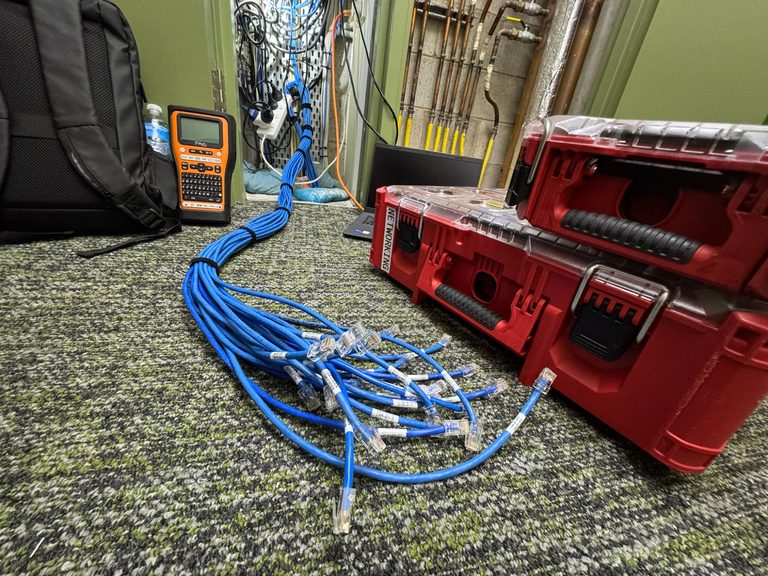
Here's the unglamorous truth of server rack cable management and network rack cable management alike: most of the mess is patch leads that are simply too long. A two-metre lead doing a thirty-centimetre job loops its spare length through the cabinet, multiplied by forty-eight ports, compounded every time someone adds one more. No amount of dressing fixes leads that shouldn't be there.
The fix isn't dressing the excess more artfully — it's removing it. We replace the lot: quality leads at measured lengths, colour-coded by function where your team wants it (uplinks, phones, APs, servers), routed through proper management hardware with velcro. Never zip ties on data cabling: they bite into the jacket, choke the pairs, and turn the next change into surgery.
The old leads leave the building with us. A dressed rack with a bag of coiled leads dumped in the cabinet floor is half a job — and half jobs are how cabinets relapse.
server rack cable management has a quiet set of standards. When a cabinet follows them, anyone can service it; when it doesn't, every job in it costs more. The essentials we install and enforce:
Server rack cable management hardware between panels and beside rails gives every lead a path instead of a drape. Racks without managers don't stay tidy — there's nowhere for tidy to live.
Zip ties over-tighten, bite jackets, and have to be cut (riskily) for every change. Velcro holds, releases, and re-wraps — the only fastener that belongs on data cabling.
Cabling routed clear of intakes and exhausts, blanking panels in unused rack units, and no cable dams in front of switch vents — the difference between a 35° cabinet and a 50° one.
Where teams want it: uplinks, voice, APs, cameras and servers on distinct lead colours — faults and changes get visibly safer when function is readable at a glance.
A deliberate, dressed service loop where future movement is likely; everywhere else, leads at measured length. Slack is where spaghetti begins.
Machine-printed, one convention, both ends of everything — the habit that turns a cabinet from a puzzle into a reference document.
The tidy photos sell the job, but the operational case is what pays for it. Three ways an unmanaged rack costs real money:
Fault time multiplies. Every outage in an unmanaged rack starts with twenty minutes of which-cable-is-it. In a managed one, the port map answers in seconds. Across a year of incidents, the tidy-up pays for itself in labour alone.
Heat kills hardware. Cable dams block the airflow switches depend on, and Queensland comms rooms run hot already. Dressed cabling restores ventilation paths — switches run cooler and die later, which is cheaper than it sounds.
Changes become risky. When nobody's sure what anything feeds, every change is a gamble and the cabinet ossifies — the network stops evolving because touching it is scary. Managed and documented, changes go back to being routine.
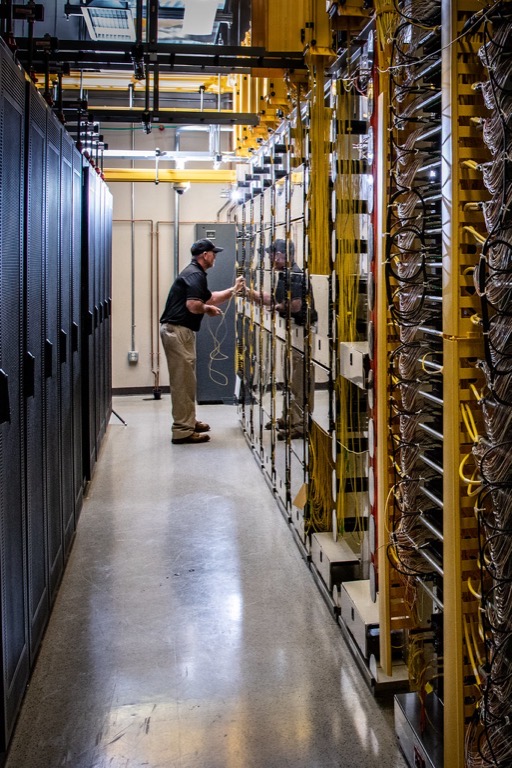
Building MDF rooms collect entropy faster than any tenant cabinet: every fitout's contractor adds their runs, nobody removes anything, and after a decade the room that serves the whole building is the room nobody can explain. The building owner carries the risk — for compliance, for insurance, and for every future tenant fitout that has to work around the mystery.
That risk is fixable, room by room. We remediate building comms rooms to AS/CA S009: per-tenant services traced, separated, and labelled; abandoned cabling stripped out; records reconciled against reality; and a documentation pack that makes the next fitout's cabler quote lower because the room finally makes sense.
For property managers running portfolios, we do this as a repeatable per-building service — same method, same documentation format, and a known fixed cost per room. Pairs naturally with MDF works when the frame itself needs more than tidying.
A photo of the rack tells us cable count and chaos level — enough for an accurate fixed price without a site visit for most single cabinets.
Every cable identified live or by tone before anything moves. The unplug-and-pray method is how outages happen; we don't use it.
Leads replaced at length, cabling dressed into management hardware, labels at both ends, abandoned runs removed — staged to keep your network live throughout.
Port map, cable register, and photos handed over — with optional quarterly maintenance so the rack never drifts back to spaghetti.
Anyone can buy velcro. The value is in the method — and in being licensed to fix what the tracing finds.
ACMA Open Cabler #42489 — when the tidy-up uncovers failed terminations or non-compliant runs (it usually does), we're licensed to fix them on the spot, not just photograph them.
Trace-first sequencing, staged re-patching, and after-hours scheduling where needed — your network stays up while its cabinet gets rebuilt around it.
White-label rack remediation for MSPs inheriting messy client sites — we make the comms room make sense, your team gets a documented baseline to manage from.
“Our rack was a disgrace. Years of “I'll tidy that later” all piled up. UNS pulled out the dead cables, labelled everything, and now you can actually trace a lead without swearing. Small job, big difference.”
A single-rack comms room tidy-up — tracing, re-dressing, patch lead replacement, labelling, and documentation — typically lands between $800 and $2,000 depending on cable count and how chaotic the starting point is. Larger rooms and multi-rack remediations are quoted to scope. Send a photo of the rack for a surprisingly accurate fixed quote — call Chris on 0412 853 618.
Minimal to none for most jobs. Re-dressing and labelling happen live with care; where ports must be re-patched, we move a few connections at a time with each verified before the next — or schedule the riskier stages after hours. For zero-tolerance environments we plan the sequence with your IT provider in advance, port by port.
Tracing and identifying every cable, replacing over-length patch leads with correctly sized ones, dressing cables into management hardware with velcro (never zip ties on data), labelling both ends of every run, re-routing anything blocking airflow or access, and handing over documentation — a port map, cable register, and photos of the finished rack.
The tidy rack is the symptom; the substance is operational. Managed cabling means faults get traced in minutes instead of hours, changes don't require archaeology, airflow isn't blocked by cable dams (heat kills switches), and nobody unplugs the wrong thing during an emergency. Property managers and insurers increasingly expect it too. The cosmetic part is free.
Yes — over-length leads looped through racks are the single biggest cause of cabinet spaghetti. We replace them with quality leads cut to the correct length, colour-coded where your team wants it, and routed through proper management hardware. Old leads are removed entirely rather than left coiled in the cabinet floor.
Always — it's the half of the job that keeps the rack tidy. You receive a port map of every panel and switch, a cable register, and photos of the finished state, as PDF plus an editable spreadsheet. Many clients pair the tidy-up with ongoing quarterly maintenance so the room never degrades back — see also cable labelling & tracing for the documentation layer on its own.
Yes — building MDF rooms and shared comms spaces are a specialty. Years of different tenants' contractors leave them chaotic, and the building owner carries the risk. We remediate to AS/CA S009, separate and label per-tenant services, document everything, and give property managers the clean handover pack that makes the next tenant fitout painless.
We service Brisbane CBD, North Brisbane, South Brisbane, Gold Coast, Sunshine Coast, Ipswich, Logan, Moreton Bay, Redlands, and the wider South East Queensland region. For larger projects, we can service regional Queensland by arrangement.
Usually saved. Most chaotic cabinets contain perfectly good installed cabling buried under bad patching and zero documentation — the remediation rescues it rather than replacing it. Where tracing exposes genuinely failed or non-compliant runs, we test them, show you the evidence, and quote fixes separately. Wholesale recabling is the rare outcome, not the default recommendation.
A quarterly half-hour visit keeps most rooms permanently tidy: new changes dressed and labelled to the convention, documentation updated, anything drifting caught early. Sites with heavy change (growing teams, frequent contractor access) suit monthly; stable small offices can stretch to six-monthly. The maintenance costs a fraction of a re-remediation — entropy is cheaper to prevent than to reverse.
Rack and comms room cable management across Brisbane CBD and metro, Logan, Ipswich, Redlands, Moreton Bay, the Gold Coast, and the Sunshine Coast — single office cabinets, multi-rack server rooms, and building MDF remediations for property managers. Send the photo you're slightly embarrassed by; fixed-price quotes come back fast, and the after photos are yours to show off. For ongoing portfolios and MSP fleets we run cable management as a standing per-site service — same standard, same documentation, every location.
One photo gets you a fixed price. A day or two of methodical work gets you a rack that's traced, dressed, labelled, documented — and stays that way.
Call 0412 853 618 Get a Quote Online Unified Network Solutions