Every camera system is only as reliable as the cable behind it — and camera cabling is registered-cabler work that security installers often rush and handymen legally shouldn't touch. We run, terminate, test and certify CCTV cabling across Brisbane: PoE for IP cameras, coax conversions, repairs, and white-label runs for the security trade.
Prefer to talk? Call Chris — 0412 853 618
New camera runs, a coax system facing an IP upgrade, or cameras that drop out every night at dusk — send the camera count and the building type, and Chris will come back with straight advice and a fixed price. Prefer to talk? Call 0412 853 618.
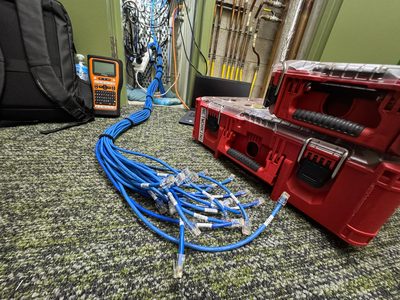
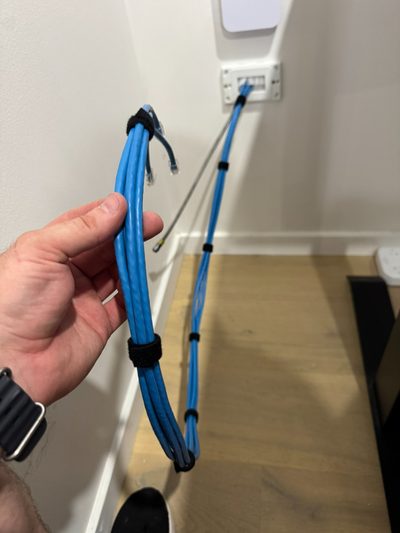
Modern CCTV is a network application: every IP camera is a PoE device on a data run, every recorder is a server, and the system inherits the quality of its cabling completely. Yet camera cabling is routinely the most rushed part of a security install — runs stapled across ceilings, terminations crimped in the dark, PoE budgets unread — and the result is the industry's signature fault profile: cameras that drop at night, blur in rain, and die in clusters.
Unified Network Solutions does cctv cabling as the structured-cabling trade it actually is. Cat6 runs routed and terminated to standard, every link tested and certified, PoE loads totalled with real camera draw figures, and the whole layer labelled and documented. It's also the legal way: in-wall camera cabling on the data network is registered-cabler work, and ACMA Open Cabler #42489 is the card we carry. Cameras from us, your security provider, or a system you already own — the copper underneath gets the same discipline.
Power over Ethernet is what makes IP CCTV elegant — one cable per camera for data and power both — and PoE budgets are what make half of Brisbane's camera systems flaky. Every switch has a total power budget shared across its ports, and cameras don't draw spec-sheet figures: infrared LEDs kick in at dusk, heaters in weather housings cycle, and pan-tilt motors spike. A system that works at 2pm and drops cameras at 2am is almost always a PoE budget discovered the hard way.
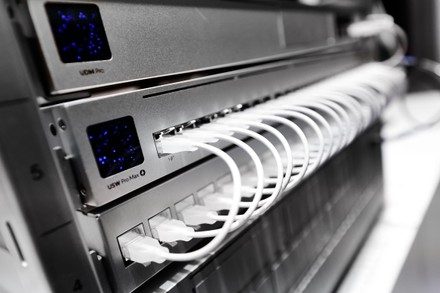
Our poe camera cabling starts with the load maths: each camera's real worst-case draw, totalled against switch capacity with genuine headroom, PoE+ and PoE++ specified where optics and heaters demand it, and injectors or local power placed where a run's length makes voltage drop matter. The switch goes in a proper enclosure on a UPS — because a camera system that reboots with every brownout misses exactly the footage you wanted.
Every ip camera cabling run is tested and certified end-to-end before a single camera is hung. Five minutes of testing per run, and the month-three mystery dropout simply never gets born.
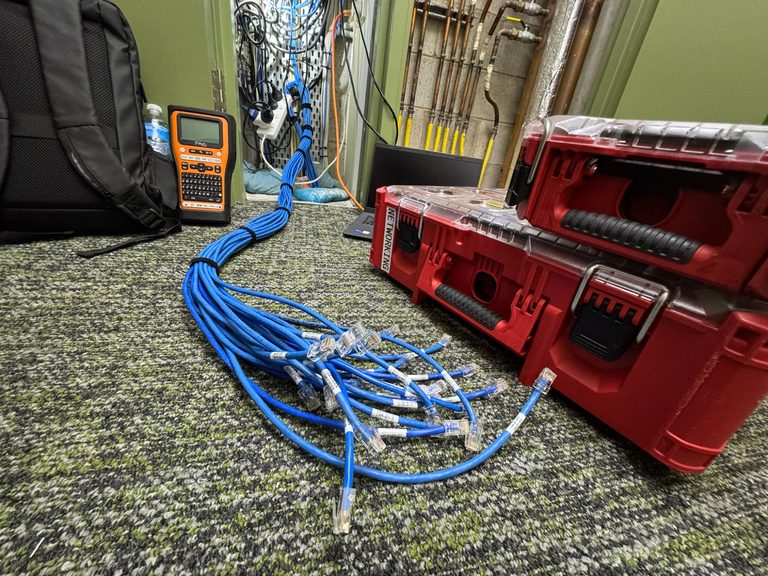
Buildings full of old RG59 face the analogue-to-IP question eventually. The answer is arithmetic, not ideology — and we price both paths.
Converters where coax is sound. Ethernet-over-coax gear carries IP video and PoE over good RG59 — the right call where re-cabling means scaffolds, asbestos plans or heritage walls.
Fresh Cat6 where it's cheaper. Converters cost per camera, forever; new runs cost once. Half our conversions land cheaper on fresh copper — we show the maths before you choose.
Test first, promise second. Existing coax gets tested before anything is quoted on top of it — because a conversion built on corroded cable just relocates the disappointment.
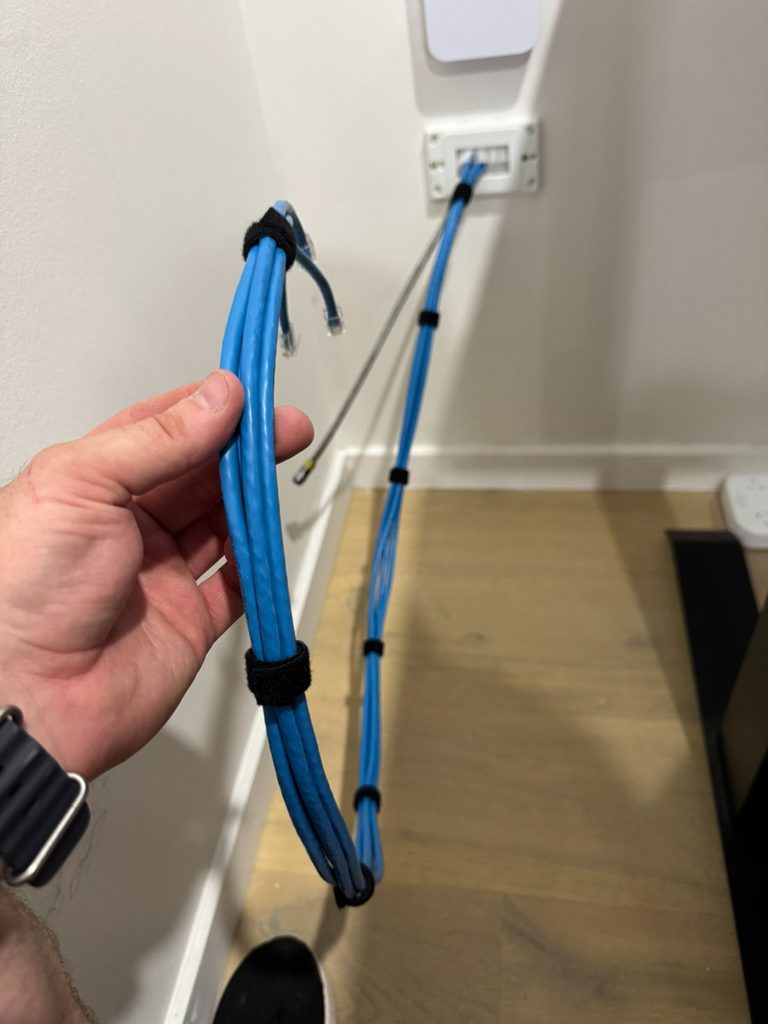
Security integrators and IT companies: the cable runs are the slowest, riskiest part of your camera installs — and the part that has to be done under a cabling registration you may not carry on every crew. We do security camera cabling as a subcontract trade: pathways, runs, terminations and certification under ACMA #42489, handed over labelled and tested so your technicians start from verified infrastructure.
White-label is welcome and normal — your branding on site, our name nowhere, test results in your handover pack. We quote fast from plans or a walk-through, hit fit-out schedules, and don't poach clients; cabling for the trade is a lane we like being good at. Multi-site rollouts, builder programs and after-hours work are all standard fare.
The same arrangement covers access control and intercom runs, rack builds and the structured cabling around them — one cabler for everything your install touches in the ceiling.
Cameras dropping at night, fuzzing in rain, or dying one by one along a corridor — before anyone sells you replacement cameras, the cabling deserves a meter. Night faults are usually PoE budgets meeting infrared load; rain faults are water in external connectors; corridor clusters are a damaged run or a failing switch port. The hardware gets blamed because the cable can't speak for itself.
Our cctv cable repair work is diagnosis-first: certify the suspect runs, measure PoE under real load, inspect external joints and entries, and name the actual fault with evidence. The fix is usually small — a re-termination, a resealed gland, a properly sized switch — and the quote says exactly what failed. If the cameras genuinely are the problem, we'll say that too, with the test results that prove the copper isn't.
It pairs with our wider network fault-finding service — same instruments, same habit of fixing causes instead of symptoms.
Six disciplines separate camera infrastructure from camera regret. Every one is visible in our handover documentation:
Data and PoE on one certified run with headroom for tomorrow's higher-resolution cameras — the cable choice you make once and never revisit.
Real worst-case draws totalled against switch capacity — infrared, heaters and motors included — so dusk doesn't become a denial-of-service.
Outdoor-rated cable, sealed glands, drip loops and conduit — Brisbane storm season is the test, and resealed joints are half our repair trade.
BYDA checks, trenched conduit at depth, gel-filled or fibre for distance — gate and car park cameras on buried runs built to outlast the fence.
Tested end-to-end before cameras hang, results in the handover pack — the five-minute discipline that deletes the month-three mystery fault.
Every run tagged at both ends, switch ports mapped, the system drawn — so the next addition is an afternoon, not an investigation.
Camera positions, pathways and the building's quirks walked and mapped — with PoE loads and run lengths captured for the design.
Runs, switching, enclosures and power designed with headroom — quoted fixed, with reuse-vs-new comparisons shown where coax exists.
Cabling installed to standard under ACMA #42489, every link tested and labelled — before a single camera goes on a bracket.
PoE proven under full load, UPS in place, documentation delivered — to you or your security installer, as verified infrastructure.
Security companies are camera specialists renting cabling skills. We're the cabling specialists they rent.
ACMA Open Cabler #42489 — camera cabling done lawfully, tested with real instruments, and documented so insurance conversations stay boring.
IP CCTV is a network workload — VLANs, PoE, switching and recording bandwidth designed by people who build networks for a living.
White-label runs for integrators, fast quotes from plans, fit-out schedules met — the subcontract cabler the security industry keeps on speed dial.
“Used UNS for the cabling and PoE on a CCTV upgrade. Every camera came online first go, the runs were tidy and the rack was labelled. Made the rest of the security install dead easy. The security company even commented on it.”
“We're an MSP and brought UNS in on a white label basis for a client's cabling job. They turned up looking professional, communicated through us properly, and the client had no idea they weren't our own crew. That's exactly how it should work. We've used them twice more since.”
Typical commercial CCTV cabling runs $180–$350 per camera point — the Cat6 run, termination, testing and labelling — varying with ceiling access, run length and building construction. A standard eight-camera small business commonly lands $1,500–$2,800 for the cabling layer, with switches and mounting hardware quoted alongside. External, underground or high-access runs are priced per the pathway work involved. Fixed quotes always — call 0412 853 618 with the camera count.
When camera cabling shares pathways with or connects to the telecommunications network — which modern IP CCTV on the data network almost always does — the in-wall and in-ceiling work falls under ACMA cabling rules and must be done by a registered cabler. UNS carries ACMA Open Cabler registration #42489, so every run we install is lawful, certified and insurable. It's a real distinction: uncertified camera cabling can void insurance arguments precisely when footage matters most.
Cat6 is the standard for ip camera cabling — it carries data and PoE power on one run, supports the distances most sites need (90m channel), and leaves headroom for higher-resolution cameras later. External runs use outdoor-rated or gel-filled cable in conduit; long external distances may call for fibre with PoE injected locally. We test and certify every run, because a camera on marginal cable is a camera that drops frames on the night you need them.
Sometimes — ethernet-over-coax converters can carry IP video and even PoE over sound RG59 runs, which suits buildings where re-cabling is genuinely hard. But converters add cost and failure points per camera, so the honest comparison is converter hardware versus new Cat6 runs. We test the existing coax, price both paths, and recommend whichever the building's access actually favours. Roughly half our conversions reuse some coax; the other half are cheaper done fresh.
Yes — security integrators and IT companies regularly subcontract their cable runs to us: we do the pathways, runs, terminations and certification under our ACMA registration, hand over labelled and tested points, and your techs hang the cameras. White-label arrangements are welcome and common — your client, your branding, our copper. Test results come with every handover, so your install starts from verified infrastructure.
Classic cabling symptoms. Night dropouts often trace to PoE: infrared LEDs lift the camera's power draw after dark, and a marginal run or an over-budget switch browns out exactly then. Rain points to water in external connectors or joints wicking moisture. We diagnose with meters rather than swapping cameras on spec — the fault is usually a $200 cabling fix, not a $2,000 camera replacement.
Power over Ethernet feeds each camera through its data cable — no separate power runs. Every PoE switch has a total power budget shared across its ports, and cameras with infrared, heaters or pan-tilt motors draw more than spec-sheet idle figures. A system designed without that arithmetic works on commissioning day and fails on the first cold, dark night at full draw. We total the real loads, size the switch with headroom, and put it on a UPS so the cameras outlast a blackout.
We service Brisbane CBD, North Brisbane, South Brisbane, Gold Coast, Sunshine Coast, Ipswich, Logan, Moreton Bay, Redlands, and the wider South East Queensland region. For larger projects, we can service regional Queensland by arrangement.
Yes — car parks, gates, sheds and second buildings are standard CCTV cabling territory: trenched conduit with proper depth and marking, gel-filled or fibre runs for distance, and PoE extended or injected locally where the maths requires it. BYDA (Dial Before You Dig) checks come first, and the work ties into our underground data cabling capability. The gate camera shouldn't be the flaky one — buried properly, it never is.
Our lane on this page is the infrastructure: runs, terminations, PoE switching, racks and certification — the layer that decides whether any camera system works reliably. We mount and connect cameras as part of cabling projects and work alongside your chosen security provider for the camera and recorder layer. For full security system design including cameras, Chris also operates Defensor Security — ask and we'll point you the right way for the whole job.
PoE camera cabling, security camera cabling for new systems and upgrades, coax-to-IP conversions, cctv cable repair and white-label runs for the security trade — across Brisbane CBD and metro, Logan, Ipswich, Redlands, Moreton Bay, the Gold Coast, and the Sunshine Coast. Every run certified under ACMA #42489, every PoE budget calculated, every system documented. Fixed pricing, trade-friendly scheduling, and cameras that stay up because the copper beneath them was never the gamble.
Camera count, building type, and whether it's new runs or fixing inherited ones — that's enough for a fixed quote. The footage only exists if the cable delivers it; we make that the certain part.
Call 0412 853 618 Get a CCTV Cabling Quote Online Unified Network Solutions