Structured cabling is the foundation every network, phone system, camera, and access point depends on. We design and install complete structured cabling systems for Brisbane offices and commercial buildings — planned around how your network actually works, and certified run by run.
Prefer to talk? Call Chris — 0412 853 618
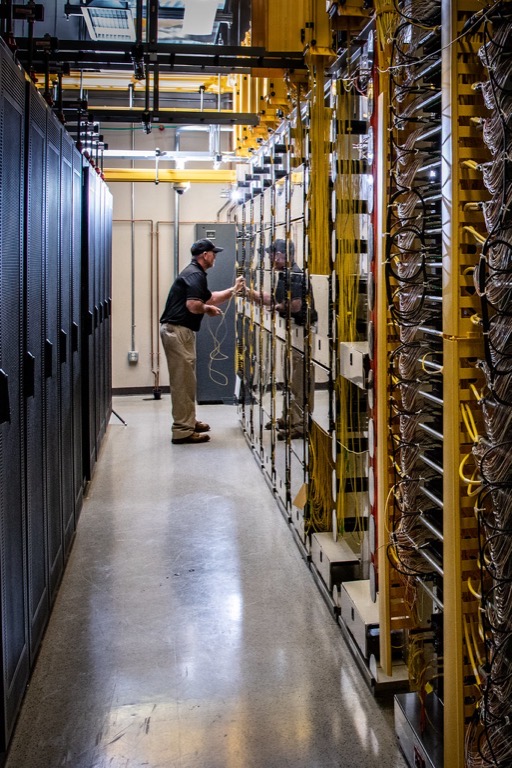
Whether it's a handful of data points or a multi-floor fitout — send through your details and Chris will get back to you with straight advice and a fixed price. Prefer to talk? Call 0412 853 618. No pushy sales, just solid work.
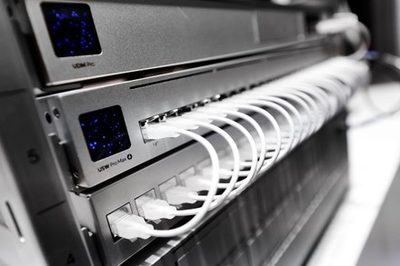
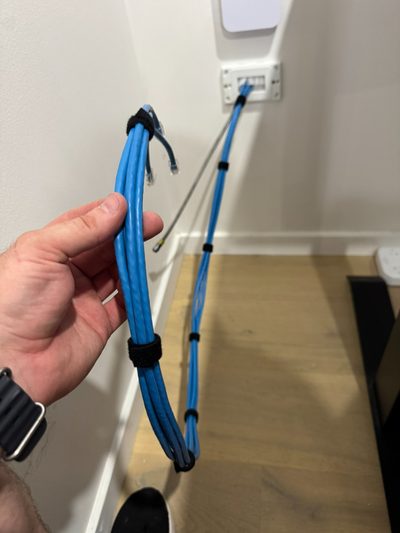
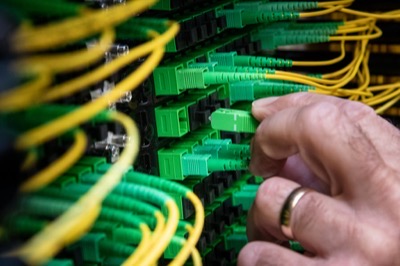
Structured cabling is the foundation of every modern business network. Without properly planned, installed, and certified cabling infrastructure, your network hardware, phones, CCTV, access control, and WiFi systems simply cannot perform reliably. Unified Network Solutions has been designing and installing structured cabling systems across Brisbane and South East Queensland for over 15 years.
We handle complete structured cabling projects for offices, commercial buildings, warehouses, retail premises, medical centres, schools, and strata properties. Our clients range from small businesses needing a handful of data points through to large commercial fitouts requiring hundreds of cable runs across multiple floors — and we also partner white-label with IT companies, MSPs, and electricians who need reliable physical infrastructure delivery.
What sets a structured cabling system apart from ad-hoc cabling is the hierarchy: standardised horizontal runs, backbone links, and patch frames that follow international standards, so data, voice, video, and building management all run over one organised platform. The payoff is practical — easier troubleshooting, simpler moves and changes, support for new technology over the same infrastructure, and a longer useful life before anything needs replacing. For most Brisbane businesses, well-planned structured cabling pays for itself within a few years through reduced IT support costs alone.
Every layer of the structured cabling hierarchy — from the wall outlet to the building's main distribution frame.
Cable pathways, data points, patch panels, and comms room infrastructure installed during the construction timeline — coordinated with builders, electricians, and project managers, designed around your actual furniture plan, not guesswork.
The high-capacity highway between your MDF and the distribution frames on each floor. Copper or fibre depending on distance and bandwidth — with proper riser management, fire-stopping, and certification.
Racks, patch panel termination, cable management, power, and labelling — built to a consistent layout methodology. We also audit and remediate disorganised comms rooms back to a professional standard.
Both shielded and unshielded variants to suit the environment — industrial sites and medical facilities typically benefit from shielded Cat6a. All runs terminated to TIA-568B and certified with Fluke DSX test results.
Single-mode and multi-mode fibre backbone for comms room links, inter-building runs, and carrier-grade installs — fusion spliced, OTDR tested, fully documented.
Machine-printed labels to AS/CA S009, cable schedules, as-built diagrams, and photos with every project — so your IT team or MSP can manage the infrastructure from day one.
Modern structured cabling carries far more than computer data. The same Cat6 or Cat6a infrastructure we install handles VoIP telephony, IP CCTV, wireless access points, access control readers, building management systems, and AV — all over one unified cabling platform. This convergence is exactly why structured cabling beats the old approach of running separate, purpose-specific cables for every system.
For a typical Brisbane office, we plan voice and data points together at each workstation, meeting room, and common area. Moving a desk no longer requires a separate phone technician — the cabling already supports both, and changes happen at the patch panel, not in the ceiling.
Because we come from an IT and networking background, we plan the cabling around how your network actually behaves — VLAN separation, PoE budgets for phones and access points, and bandwidth headroom for growth — rather than just pulling cable to a count.
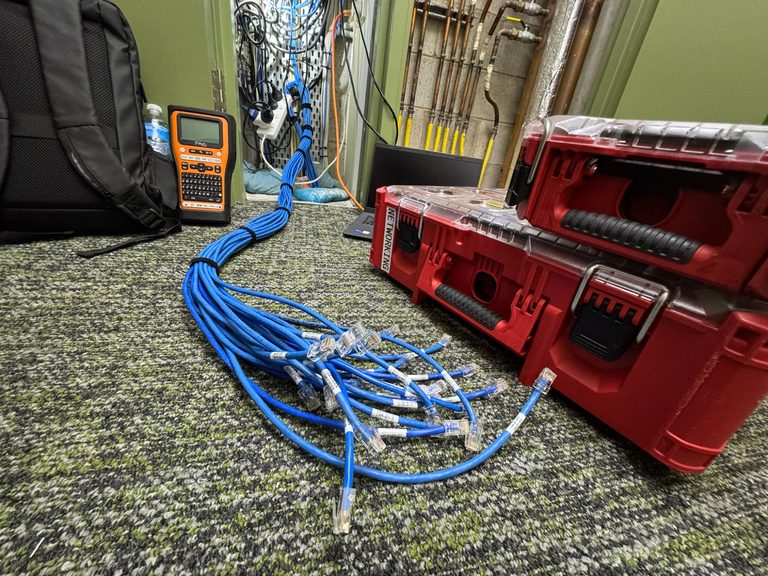
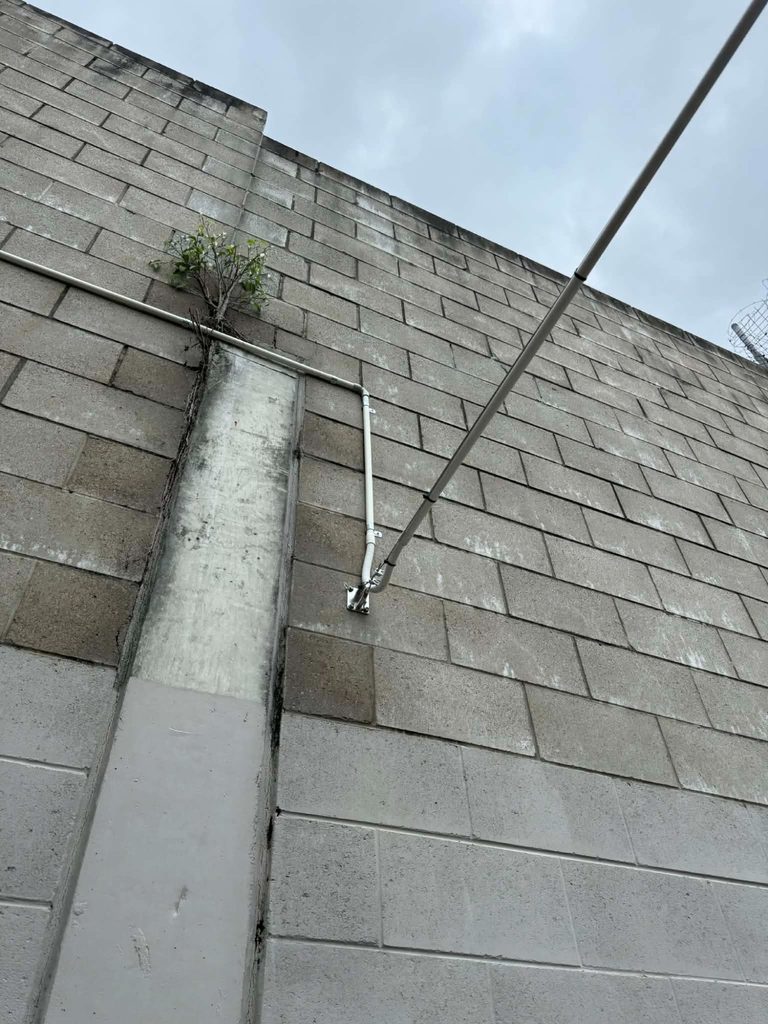
A structured cabling system is built in two layers. Horizontal cabling is the run from the floor's communications cabinet out to each individual outlet — the cable behind every wall plate at every desk, camera, and access point. These Cat6 or Cat6a runs make up the bulk of the cable count on most jobs.
Backbone cabling — vertical or riser cabling — is the high-capacity link tying floor cabinets back to the building's main distribution frame. This is where fibre usually earns its place: a single fibre pair can carry a whole floor's traffic without breaking a sweat, over far greater distances than copper allows.
On a multi-storey fitout we design both layers together — horizontal Cat6a to every outlet, fibre or copper backbone up the riser — so capacity scales cleanly from the desk to the comms room. Getting that hierarchy right at install time is what stops a building hitting a bandwidth wall a few years later.
The two ends of a structured cabling project: getting cable into the building at the right construction stage, and terminating it into a comms room that stays manageable for a decade.
Office fitout cabling is the most common structured cabling project we deliver, and timing is everything. We complete rough-in during the framing and pre-lining stage — routing cable through wall frames and ceiling spaces before plasterboard goes up — then return for final fix once walls are closed: wall plates, patch panel termination, testing, and labelling.
We coordinate with your builder and project manager so our work aligns with the program and never holds up other trades. Floor boxes for desk clusters, ceiling-mounted access point positions, and meeting room AV all get planned into the pathway design up front, because retrofitting them after handover costs three times as much.
Every fitout hands over with a detailed cable schedule and as-built documentation, so your IT team or MSP can commission the network the day the office opens.
The MDF (Main Distribution Frame) is the central hub where all cabling terminates and external services enter the building. A well-designed MDF makes ongoing maintenance straightforward; a bad one costs you money every time a technician opens the door.
Every MDF we build follows the same layout methodology — structured top to bottom, left to right, with clear separation between voice, data, and fibre services. This isn't aesthetic fussiness: it directly reduces fault-finding time and makes future upgrades simpler.
For existing buildings, we provide MDF audits and remediation — re-dressing, re-labelling, and re-documenting disorganised comms rooms back to a professional standard, usually without replacing the cabling itself.
Every structured cabling installation in Australia is governed by standards that keep cabling safe, reliable, and serviceable — and any work on customer cabling must be performed by an ACMA-registered cabler. UNS holds Open Cabler Registration #42489.
AS/CA S009 — the wiring rules for customer cabling: separation from electrical wiring, bonding, bend radius, fire-stopping, and labelling. Non-compliant work can void insurance and create faults that are expensive to find later.
AS/NZS 3080 — telecommunications pathways and spaces: how cabling routes through a building, riser management, and comms room layout.
TIA-568 category standards — how each Cat6 and Cat6a link must perform. Our Fluke DSX results prove every run meets its category, and the as-built pack demonstrates S009 compliance — a paper trail that matters to landlords, body corporates, and regulated industries as much as the cabling itself.
We visit your site to assess the infrastructure, access conditions, and requirements. For structured cabling, understanding the physical environment is essential for accurate scoping.
A detailed scope of work with a fixed price — components, labour, and trade coordination broken down. No hourly rates, no hidden extras.
Licensed, insured technicians complete the work around your operations. Every run is tested with the Fluke DSX and certified before handover.
As-built diagrams, test reports, cable schedules, labelling records, and photos — your IT team or MSP can manage the infrastructure from day one.
We're not just installers — we come from an IT background, which means we understand the systems and networks that depend on the infrastructure we build.
ACMA Open Cabler registered (#42489) with comprehensive insurance. Every installation meets Australian telecommunications standards and AS/CA S009.
Structured cabling and network infrastructure across South East Queensland — offices, high-rises, warehouses, schools, and medical sites.
White-label field partner for IT companies and MSPs who need reliable physical infrastructure without maintaining their own field team.
“Honestly the cabling ended up being one of the least stressful parts of our fitout, which I did not expect. They turned up when they said they would, didn't get in the way of the other trades, and the comms rack looks like someone actually cared. Would use them again.”
Costs depend on the number of cable runs, cable category (Cat6 vs Cat6a), pathway requirements, and site access conditions. We provide fixed-price quotes after a site survey — no hourly rates or hidden extras. Most office fitouts range from $150–$250 per data point installed, terminated, tested, and certified. Call Chris on 0412 853 618 for a quote on your project.
A complete structured cabling installation covers the full hierarchy: horizontal Cat6 or Cat6a runs from each floor's communications cabinet out to every wall outlet, backbone links tying those cabinets back to the building's main distribution frame, patch panel termination at both ends, cable management and containment, professional labelling to AS/CA S009, Fluke DSX certification of every run, and a complete as-built documentation pack. We also coordinate with builders and electricians during a fitout so the cabling is roughed in at the right stage.
Cat6 supports gigabit Ethernet (1Gbps) up to 100 metres and is suitable for most office environments. Cat6a supports 10-gigabit Ethernet (10Gbps) at the same distance and offers better noise rejection. Cat6a costs roughly 15-20% more but provides significantly more future-proofing — and it handles high-wattage PoE++ devices with better heat behaviour.
A small office of 10 to 20 outlets is usually one to two days. A full-floor commercial fitout of 80 to 150 outlets with backbone and a comms room build typically runs one to two weeks, often staged around the builder's program. Retrofits into live, occupied spaces take a little longer because we work around your operations and can schedule after-hours where downtime is a concern. We give you a clear program at the quoting stage.
Yes. A properly designed structured cabling system carries voice, data, CCTV, wireless, access control, and building services over one unified platform. VoIP phones run over the same Cat6 or Cat6a outlets as your computers, and where a traditional phone system is still in use we terminate voice services onto the patch frame alongside data. Moves, adds, and changes are handled at the patch panel rather than by pulling new cable.
Yes. Every cable run is tested with a Fluke DSX CableAnalyzer and you receive permanent link or channel test results as part of your handover documentation. This certification proves the installation meets the relevant standard and gives you a baseline for future fault-finding.
Absolutely. We regularly work as a white-label partner for IT companies and MSPs across Brisbane. We handle the physical infrastructure — installation, testing, documentation — while your team manages configuration and client relationships.
We service Brisbane CBD, North Brisbane, South Brisbane, Gold Coast, Sunshine Coast, Ipswich, Logan, Moreton Bay, Redlands, and the wider South East Queensland region. For larger projects, we can service regional Queensland by arrangement.
From single-tenancy offices to multi-storey commercial towers, we provide structured cabling services across Brisbane CBD, Fortitude Valley, South Brisbane, West End, Newstead, Woolloongabba, Spring Hill, and the surrounding suburbs — plus Redlands, Moreton Bay, Logan, Ipswich, Gold Coast, Sunshine Coast, and Toowoomba. Whether your site is a high-rise in the CBD, a warehouse in Brendale, a medical centre on the Gold Coast, or a school on the Sunshine Coast — we have the experience and logistics to deliver on time and on budget. Site surveys are free, quotes are fixed-price, and every job ends with certification and documentation in your hands.
Tell us about your project and we'll come to site, scope the work, and provide a fixed-price quote — designed, installed, certified, and documented by a registered cabler.
Call 0412 853 618 Get a Quote Online Unified Network Solutions