Linking buildings, crossing car parks, getting data to the gatehouse or the shed out back — underground is the permanent way to do it. We trench, bore, lay conduit and pits to spec, haul the cable, and certify the lot. Buried properly, documented properly, never touched again.
Prefer to talk? Call Chris — 0412 853 618
A driveway crossing or a whole-site trench run — send through your details and Chris will get back to you with straight advice and a fixed price. Prefer to talk? Call 0412 853 618. No pushy sales, just solid work.
Underground data cabling is the permanent answer to problems wireless can't solve — linking separate buildings, reaching gatehouses and sheds, crossing car parks and driveways, and getting carrier services into a site. Done right, it disappears into the ground and works for decades. Done wrong, it's a dig-it-up-again bill waiting to happen.
Unified Network Solutions delivers complete underground cabling projects across Brisbane and South East Queensland: BYDA enquiries and service locating before any excavation, trenching or directional boring to suit the surface, conduit and communications pits installed to standard, cable hauling, termination, and Fluke or OTDR certification at both ends. As ACMA Open Cablers (#42489), every job is compliant with AS/CA S009 and documented in an as-built pack recording the route, depths, and test results.
Every part of getting data from A to B underground — from the saw cut to the certified termination.
Open trenching through lawn, garden, and unsealed ground — dug to the right depth for the surface above, bedded, conduited, marked with warning tape, and reinstated so you'd barely know we were there.
Where trenching isn't an option — under driveways, car parks, roads, and established landscaping — we bore underneath and push conduit through without disturbing the surface.
Heavy and standard-duty communications conduit with draw ropes, correctly graded and jointed, sized with spare capacity — because the second cable you'll want in three years should cost a haul, not a dig.
Access pits at direction changes and junctions — the right size and load class for their location, so future hauling and fault-finding doesn't mean excavation.
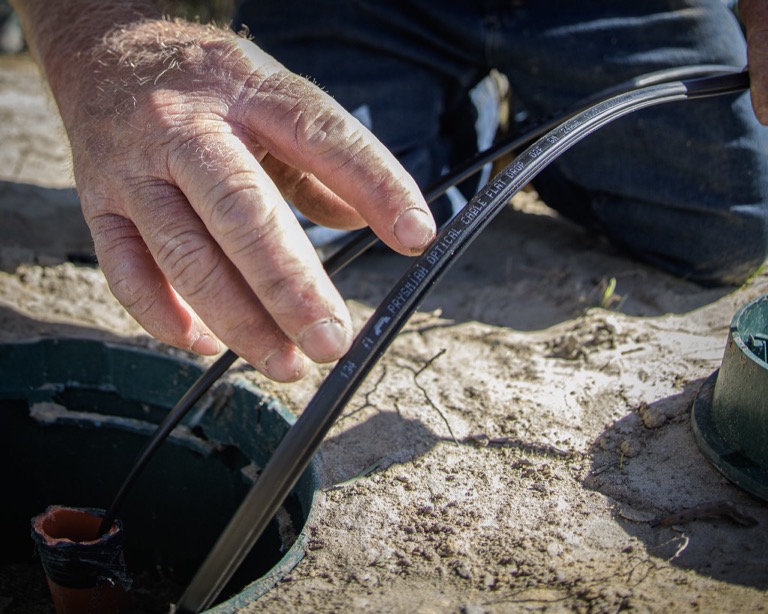
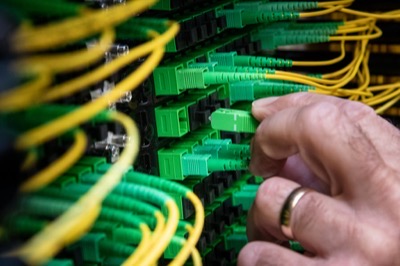
Outdoor-rated and gel-filled fibre optic cable hauled, spliced, and OTDR-certified — the right answer for distance, lightning isolation, and bandwidth between buildings.
Outdoor-rated copper for shorter runs within the 100-metre Ethernet limit — gel-filled, conduited, terminated and certified like any other run we install.
The most common reason Brisbane businesses call us for underground data cabling: linking two buildings on the same site. A main office to a workshop, a warehouse to a gatehouse, a clinic to a second tenancy across the car park. Running data underground between buildings is the reliable, permanent way to do it — far better than trying to bridge the gap with wireless that weather, distance, and obstructions work against.
The copper-or-fibre decision comes down to distance and the electrical environment. Ethernet over copper is limited to 100 metres and can be affected by differences in earth potential between separate buildings — a real issue with buried runs. Beyond that distance, or where the buildings are on different electrical supplies, underground fibre is the right answer: no distance limit at this scale, and complete electrical isolation between the buildings.
We advise on the right approach for your specific run rather than defaulting to one — and we put it in writing with the quote so you know exactly what's going in the ground and why.
Where underground cabling has to connect into the carrier network — a new lead-in, a site getting its first business connection, or a subdivision being readied for services — the pit and pipe has to be installed to the carrier's specification, not just "a conduit in the ground." We install communications pits and the conduit between them to Telstra and NBN requirements: the right pit size and class for the location, correctly graded conduit with draw ropes, bend limits the carrier's haulers will actually accept, and clearances from other services.
Getting this right the first time matters because the carrier inspects before they'll haul cable through it. A pit that's the wrong class, a conduit with too sharp a bend, or a missing draw rope means a failed inspection and a return visit. We build it to spec so your NBN lead-in conduit passes and the connection isn't held up by the civil works.
Before any spade goes in the ground, we know what's already down there. It's not bureaucracy — it's the difference between a clean job and a genuinely dangerous one.
BYDA on every job. We lodge a Before You Dig Australia (formerly Dial Before You Dig) enquiry for every excavation, identifying registered power, gas, water, and telecommunications along the route. No exceptions, no shortcuts.
Locating where plans run out. On commercial sites with a history of unrecorded works, we engage cable locating — because the asset plans don't always match what's actually buried.
Priced in, not bolted on. Striking a live power cable or gas main is a safety and liability event; hitting an existing comms line is an outage and a repair bill. Proper locating is built into how we price and program every trenching and boring job.
Two decisions shape every underground cabling job: how the cable is protected in the ground, and how the ground looks when we leave.
Direct burial cable — armoured cable laid straight into the trench — has its place on long rural runs where conduit costs outweigh the benefit. But for commercial sites in Brisbane, we conduit almost everything, and the reasoning is simple: the trench is the expensive part. Once it's open, the marginal cost of laying conduit instead of bare cable is small, and the payoff is permanent.
Conduit means the cable can be replaced or upgraded later by hauling, not digging. It means a lightning-damaged run or a future fibre upgrade is an afternoon's work instead of a second civil project. And with a draw rope left in place and spare capacity sized in, the next cable your site needs goes in for the cost of the haul.
Where we do use direct burial, it's deliberate: gel-filled, armoured, rated for the soil conditions, with warning tape above and the route recorded precisely in the as-built — because the protection that conduit would have given has to come from somewhere.
The part most people worry about with trenching is what their site looks like afterwards. Reinstatement is quoted as part of every job, not left as your problem: turf relaid over lawn runs, garden beds put back, and saw-cut concrete or asphalt patched properly.
On commercial premises we plan the route to minimise visual impact in the first place — following fence lines, garden edges, and existing service corridors rather than carving the shortest line across the middle of a manicured frontage.
Every route also goes into the as-built documentation with depths and offsets recorded, so your future landscaper, builder, or fencing contractor knows exactly where not to dig. That document costs nothing extra and has saved more than one client a severed link years later.
We walk the route, assess surfaces and distances, lodge the BYDA enquiry, and arrange locating where the site history calls for it.
Method (trench or bore), conduit spec, pits, cable, termination, and reinstatement — itemised with a fixed price. No surprises when the digging starts.
Trenching or boring, conduit and pits installed to standard, cable hauled and terminated at both ends by registered cablers.
Fluke or OTDR certification, surfaces reinstated, and an as-built pack recording route, depths, and test results for whoever digs next decade.
We're not just installers — we come from an IT background, which means the cable in the trench is planned around the network it serves.
ACMA Open Cabler registered (#42489) with comprehensive insurance. Every installation meets Australian telecommunications standards and AS/CA S009.
One contractor for the civil work, the conduit, the haul, the termination, and the certification — no juggling an excavator contractor and a cabler who blame each other.
White-label field partner for IT companies and MSPs whose clients need underground links — we do the dirty work, you keep the relationship.
“We needed cabling run between two buildings and I was dreading it because I'd heard horror stories about underground runs. UNS talked us through the options upfront, organised the whole thing, and tested it after. Eighteen months on and zero issues.”
Costs depend on the route length, the surface (lawn vs concrete vs road crossing), whether we can open-trench or need to bore, and the cable being hauled. We provide fixed-price quotes after a site survey so you know exactly what you're paying before any work begins. Contact us on 0412 853 618 for a free consultation and quote.
Burial depth depends on where the cable runs and what's above it. As a general guide, communications cabling in conduit is laid around 300–500mm deep in landscaped or pedestrian areas, and deeper — typically 600mm or more — under driveways, roadways, and anywhere subject to vehicle loading. Cable under a trafficable area is also run in heavier-duty conduit for mechanical protection. We set the depth and conduit class for each section of the route based on what it passes under and the relevant standards, and record it in the as-built documentation so it's known for any future works.
Always. Before any excavation we lodge a Before You Dig Australia (BYDA, formerly Dial Before You Dig) enquiry to identify buried power, gas, water, and telecommunications along the route, and on commercial sites we engage cable locating where the plans are incomplete. Striking a live service is a serious safety and liability event, so locating before we dig is non-negotiable and is built into how we price and program the work.
Yes. Crossing a driveway, car park, or road is one of the most common underground jobs we do. Where we can't open-trench across a sealed or trafficable surface, we use boring (directional drilling) to push conduit underneath without disturbing the surface, then haul the cable through. Under any trafficable area the conduit is a heavier class and buried deeper for mechanical protection. We assess the crossing during the site survey and quote the right method — open trench or bore — for your surface.
The full scope: BYDA enquiry and service locating, trenching or boring, conduit installation with draw ropes, communications pits, cable hauling (Cat6, Cat6a or fibre), termination at both ends, testing and certification, and reinstatement of the surface. Every project includes a site survey, fixed-price quotation, and as-built documentation recording the route and depths.
Yes. We provide underground data cabling for both new builds and existing occupied sites. For existing premises we assess the route during a site survey — existing conduits are reused where serviceable, and new trenching or boring is planned to minimise disruption to driveways, gardens, and business operations.
Absolutely. We regularly work as a white-label partner for IT companies and MSPs across Brisbane. We handle the physical infrastructure — trenching, conduit, hauling, termination, testing, documentation — while your team manages configuration and client relationships. No poaching, no branding, complete discretion.
We service Brisbane CBD, North Brisbane, South Brisbane, Gold Coast, Sunshine Coast, Ipswich, Logan, Moreton Bay, Redlands, and the wider South East Queensland region. For larger projects, we can service regional Queensland by arrangement.
We deliver underground data cabling across Brisbane and the wider region — commercial sites, industrial estates, schools, medical campuses, and multi-building properties in Logan, Ipswich, Redlands, Moreton Bay, the Gold Coast, and the Sunshine Coast. Whether it's a ten-metre driveway crossing in Daisy Hill or a multi-pit conduit network across an industrial yard in Brendale, the standard is the same: located before we dig, built to spec, certified at both ends, and documented for whoever comes next. Site surveys are free and quotes are fixed-price.
Tell us what you need linked and we'll walk the route, lodge the BYDA, and give you a fixed-price quote — trenched or bored, conduited, hauled, certified, and reinstated.
Call 0412 853 618 Get a Quote Online Unified Network Solutions