OTDR testing for Brisbane businesses — per-core traces, light source and power meter measurements, certification against link loss budgets, and fault location when a link is misbehaving. Independent testing of any installer's fibre, including ours.
Prefer to talk? Call Chris — 0412 853 618

A new install to certify, a handover you don't quite trust, or a link that drops when it rains — tell us what you're seeing and Chris will quote the testing as a fixed price. Prefer to talk? Call 0412 853 618. No pushy sales, just solid work.
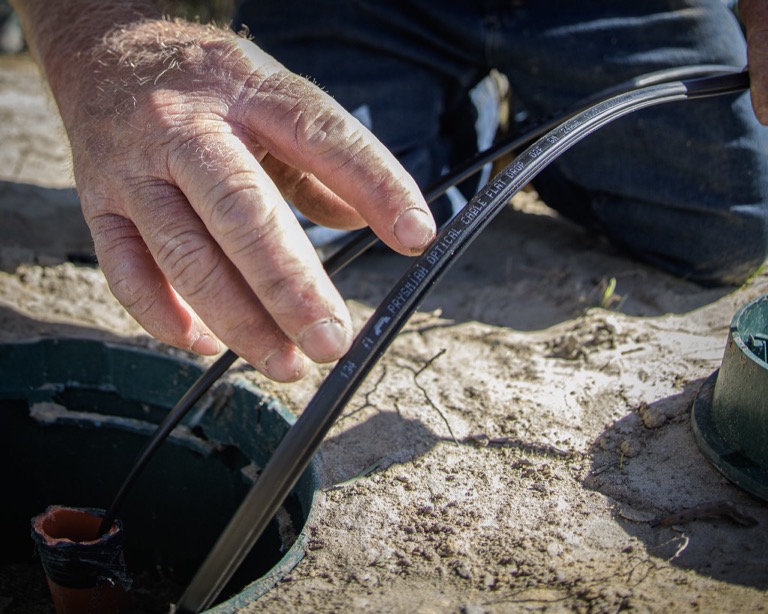
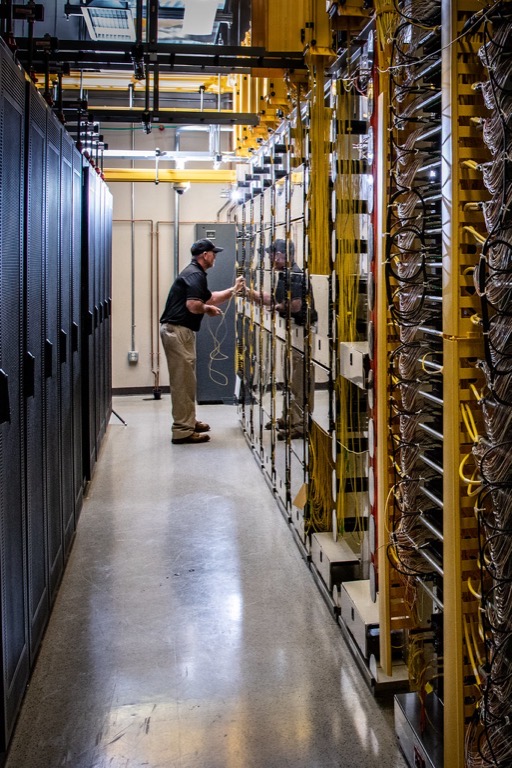
Professional OTDR testing Brisbane businesses use to certify new fibre, prove existing links, and locate faults to the metre. We test every core, certify against the loss budget, and provide independent certification of fibre installed by others. Part of our fibre optic cabling service.
On this page:
Need OTDR testing Brisbane for a new install, a handover, or a fault you can't find? An OTDR (Optical Time Domain Reflectometer) sends light pulses down the fibre and measures the reflections to map the entire link — the loss of every splice, connector and bend, and the exact distance to any break. It is how professional fibre is certified, and how faults are located without guesswork.

We test and certify every core we install, and we provide independent certification of fibre installed by electricians, other cablers or building contractors — common for new-building handovers and compliance audits where the client wants a second, impartial set of test results.
Two test methods cover most work. OTDR gives the full trace — event-by-event loss and fault distance. Light source & power meter (LSPM) gives the true end-to-end insertion loss the equipment will actually see. We use both where the job warrants it, and verify the results against the link's loss budget.
As an ACMA Open Cabler (#42489) with the right test gear, you get certified, auditable results — not a verbal “it works.” The same testing discipline applies to our copper cable certification.
What We Do
Looking for fibre optic testing Brisbane businesses actually trust? That's exactly what we deliver — surveyed, quoted fixed-price, and documented at handover. Every fibre optic testing project we take on follows the same discipline: clear scope, tidy workmanship, and documentation your team can use. From single-site jobs to multi-site rollouts, our fibre optic testing work covers Brisbane, Logan, Ipswich, the Gold Coast and the wider south east.
The two instruments answer different questions. A light source and power meter (LSPM) measures total end-to-end loss: shoot a known light level in one end, measure what arrives at the other. It's the definitive number for "does this link meet its loss budget?" — simple, absolute, and required by most certification standards.
The OTDR answers the harder question: where is the loss? It fires pulses down the core and reads the reflections, producing a trace that itemises every event along the link — each splice, each connector, each bend — with its individual loss and its distance from the launch point. A link can pass a total-loss test while hiding a marginal splice that will fail as it ages; the OTDR is what finds it while it's still a line item instead of an outage.
Proper fibre optic testing uses both: LSPM for the certified end-to-end number, OTDR for the event-by-event evidence. That's how we test, and it's why our handover packs settle arguments instead of starting them.
At handover. A new installation — ours or anyone's — should come with per-core test results against a calculated loss budget. If a contractor's "certification" is a single green light on a cheap tester, independent OTDR testing before you sign off is cheap insurance on infrastructure you'll own for a decade.
When buying, leasing or moving into a building. Existing fibre of unknown history is either an asset or a liability, and testing is how you find out which. A few hundred dollars of fibre optic testing has saved clients from budgeting a full re-cable — and, in the other direction, from assuming dark fibre was usable when half the cores were broken.
When something's wrong. Intermittent drops, links that fail in the heat or the wet, throughput that never matches the spec — the OTDR turns "it's being weird" into "there's a 1.8 dB event at 214 metres, at the pit near the driveway." From there, the repair is a known job at a known location, not an exploration.
Before warranty expiry or contractor disputes. Test results are evidence. Whether it's holding an installer to their workmanship warranty or proving to a landlord that the building riser fibre was damaged after your fitout, traces with timestamps end conversations that opinions can't.
Fibre optic testing is priced by the core, with a job minimum that covers mobilisation and setup — so certifying a 4-core link and certifying a 48-core backbone are very different numbers, but both are fixed before we arrive. The per-core price drops as counts rise, because the setup cost amortises: the expensive part of OTDR testing is being on site with calibrated instruments, not the extra ten minutes per core.
What moves the price beyond core count: access (two ends in two buildings, or a locked riser needing an escort, versus two cabinets in one comms room), connector condition (dirty or damaged connectors need inspection and cleaning before a meaningful test), and whether you need bidirectional traces — shot from both ends and averaged, the gold standard for certification and the default for handover disputes.
What you get back is the point. Every fibre optic testing job hands over: per-core OTDR traces in native and PDF format, a results table against the calculated loss budget, LSPM end-to-end figures where specified, and a plain-English findings summary — what passed, what's marginal, what failed and where. It's a document set your IT provider, consultant or lawyer can act on, and it's yours to keep against the day someone asks "was that fibre ever actually certified?"
We confirm core counts, connector types and distances — from your documentation if it exists, or by inspection if it doesn't. That sets the loss budget each core has to meet.
Every core gets an OTDR trace showing each splice, connector and bend event — backed by light source and power meter readings for absolute end-to-end loss.
Results are compared against the calculated link loss budget for your fibre type and distance. Marginal cores are flagged, failed events are located to the metre.
You receive the traces, a per-core results table and plain-English findings — what passed, what failed, where the fault is, and what fixing it involves.
A link that flaps under load, a handover pack that never arrived, or fibre of unknown history in a building you've just moved into — testing turns doubt into a documented answer.
Independent certification before you accept a site, or fault location when the client's "internet is down between buildings" ticket lands on you. Traces you can attach to the job, white-label.
Practical completion needs proof the fibre meets spec. We test and certify installations at handover — including work by other contractors — so the defect list is settled with data, not argument.
1. Where every dB goes. An OTDR trace itemises the loss at each splice, connector and bend — not just a total. That's what makes faults findable and quality provable.
2. Whether it meets the budget. Pass/fail means nothing without a calculated link loss budget for your distance, fibre type and connector count. We test against the number, not a feeling.
3. What to do about it. A marginal splice, a dirty connector and a macro-bend all fail differently. The report tells you the fix, not just the failure.
Calibrated OTDR and light source/power meter — the same instruments used to certify carrier fibre, matched to single-mode and multi-mode work.
We certify every core we install ourselves, so testing isn't an add-on service — it's how we already work, applied to anyone's fibre.
Findings written for the people who run the network — your IT team gets loss figures and locations, your PM gets a pass/fail table for the defect list.
An OTDR maps the entire fibre link — the loss of every splice and connector, plus the exact distance to any fault. You need it to certify a new install performs to spec, and to locate faults without digging up the whole run. The trace is your auditable proof the link is good.
Yes — independent certification is a service we provide regularly, especially for new-building handovers and compliance audits. We test the cores, certify against the loss budget, and give you an impartial set of results.
OTDR gives a full trace showing every event and fault distance along the fibre. A light source and power meter gives the true end-to-end insertion loss the equipment will see. We use both where the job warrants it.
Yes — an OTDR pinpoints breaks and high-loss events to the metre, which is how we locate faults before repair. See fibre optic repairs; emergency fault location starts from $1,200 + GST.
Always. You receive the OTDR traces and/or LSPM results for every core as part of your handover documentation — auditable records for compliance and warranty.
It depends on core count and access. Testing is included in every install we do; standalone testing and independent certification is quoted on scope. Call Chris on 0412 853 618.
Yes. The OTDR and light source carry modules for both single-mode (1310/1550 nm) and multi-mode (850/1300 nm) wavelengths, so one visit covers a mixed estate — say, a single-mode campus backbone plus multi-mode patching inside the data room. Each fibre type is tested at its proper wavelengths against its own loss budget; results are reported per core, per wavelength.
Every job hands over per-core OTDR traces (native files plus PDF), a results table comparing each core against its calculated loss budget, light source and power meter end-to-end figures where specified, and a plain-English findings summary — what passed, what's marginal, what failed and at what distance. It's written so your IT provider can act on it and a project consultant will accept it as certification.
Not on a lit core — shooting an OTDR into an active link risks the equipment and gives meaningless results, so cores under test must be dark. But that rarely means an outage: spare cores can be tested any time, and lit services are usually moved to tested spares one at a time so each core gets certified without dropping the site. For genuinely single-core links, we schedule a brief agreed window, often after hours.
OTDR testing and fibre certification across Brisbane CBD and metro, Logan, Ipswich, Redlands, Moreton Bay, the Gold Coast, the Sunshine Coast and Toowoomba. Single links or whole-campus test programmes — every core traced, measured and reported against its loss budget.
Fixed-price OTDR testing with traces and plain-English findings at handover. Call Chris or send the form — straight answers within one business day.
Call 0412 853 618 Get a Quote Online Unified Network Solutions